
Leroy-Somer vs Stamford alternators: what’s the difference (and why we offer both)
January 28, 2026
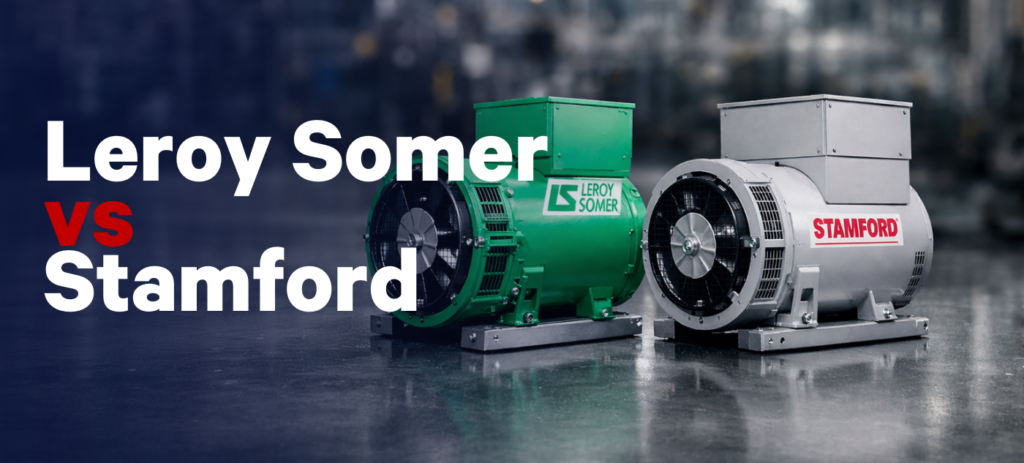
When you’re specifying a generator, the engine usually gets the headlines — but the alternator is the component that actually makes the electricity your site depends on. Two names come up again and again in professional genset builds: Leroy-Somer and Stamford.
We routinely supply diesel generators with either brand, (as well as many others), because they’re both proven, widely supported, and trusted across industrial and commercial applications. The “best” choice depends on your load type, site conditions, and priorities (motor starting, harmonics, cost, serviceability, etc.).
Below is a clear, practical comparison — with the benefits and selling points of each.
Quick refresher: what the alternator affects
The alternator choice influences:
- Voltage stability (how well it holds steady as loads switch on/off)
- Motor starting performance (pumps, compressors, lifts, HVAC)
- Handling of non-linear loads (UPS systems, VSDs, LED lighting, IT)
- Short-circuit performance (fault clearing capability in some setups)
- Efficiency & heat handling (especially at high ambient temps)
- Serviceability, parts availability, and support long term
Stamford alternators: key benefits and selling points
Stamford alternators are extremely common in genset packages worldwide, which brings a couple of practical advantages that matter in the real world.
1) Familiarity and global support
Why it sells: Many engineers, installers, and service companies know Stamford products inside-out. That often translates to:
- Faster fault diagnosis
- Easier access to compatible AVR options and spares
- Confidence for multi-site operators standardising fleets
2) Strong performance across mixed commercial loads
Why it sells: Stamford units are frequently specified for general commercial standby where the load mix changes through the day (lighting + HVAC + small motors + office loads). They’re known for solid regulation and predictable behaviour under step loads.
3) Good options for excitation and regulation
Why it sells: Stamford ranges commonly offer multiple excitation/AVR configurations (often including auxiliary winding/PMG options depending on model), which helps tailor performance for:
- Better voltage recovery on load steps
- Improved motor starting behaviour
- More stable output with “messier” electronic loads
4) Standardisation for large fleets and consultants
Why it sells: Because Stamford is so frequently written into specs, choosing Stamford can reduce “approval friction” on projects where:
- A consultant has a preferred alternator list
- A client wants consistency across sites
- A facilities team wants common parts/training
Best fit when: you want a widely recognised alternator brand with broad service familiarity, and you’re building a dependable, easy-to-support generator package for typical commercial/industrial standby duties.
Leroy-Somer alternators: key benefits and selling points
Leroy-Somer (often seen on premium European spec gensets) is another top-tier option — and in certain applications it can be a very compelling choice.
1) Excellent voltage recovery and motor-start capability (when configured for it)
Why it sells: Many Leroy-Somer configurations are designed to deliver strong transient response — especially valuable where you have:
- Larger DOL motor starts
- Heavier “first hit” loads (site welfare, plant rooms, agriculture, workshops)
- Higher step loads where you want quick voltage recovery
2) Robustness in demanding environments
Why it sells: Leroy-Somer alternators have a strong reputation in applications where heat, dust, and long run hours are part of life:
- Industrial and construction duty
- Remote sites
- Prime/continuous-ish running patterns (where appropriately specified)
3) Flexible options for non-linear loads (UPS/VSD/IT-heavy sites)
Why it sells: With the right alternator sizing and excitation options, Leroy-Somer packages are often chosen where power quality matters and loads include:
- UPS systems
- Variable speed drives
- Data/comms equipment
- Large LED lighting banks
(The alternator is only part of the story here — correct sizing, engine response, and overall system design matter too.)
4) Strong “spec-led” appeal
Why it sells: For buyers who care about component pedigree, Leroy-Somer is a name that signals a premium build and can be attractive in tender documents and high-expectation sites.
Best fit when: you’re prioritising strong transient performance, tougher site conditions, or a premium component specification — particularly where loads are motor-heavy or electronically complex.
So what’s the real difference?
In practice, it’s less “one is better” and more “which is better for your load and site”.
Here are the decision factors we use when advising customers:
Choose based on your load profile
- Motor-heavy sites (pumps, compressors, HVAC plant): alternator transient response and excitation options matter most.
- UPS / VSD / IT-heavy sites: focus on stability under non-linear loads, heat handling, and correct oversizing strategy.
- General standby for buildings: both are excellent; support preferences and standardisation often decide.
Choose based on support and standardisation needs
- If your maintenance team already stocks parts and knows one brand, that’s a genuine advantage.
Choose based on budget and lead time
- Availability can change project-to-project. Having both options means we can often protect your schedule without compromising the spec.
The “best alternator” is the one matched to your generator design
A high-quality alternator can still underperform if the system isn’t designed around the real site demands. The right answer usually comes from these checks:
- Starting method and kW/kVA of the biggest motor
- Expected step loads (what turns on first in a mains failure)
- Presence of UPS, VSDs, welding equipment, or other non-linear loads
- Ambient temperature and ventilation
- Required voltage dip limits and recovery times (if you have a written spec)
Bottom line: why we offer both
We offer Leroy-Somer and Stamford because they’re both proven, premium alternator choices — and having both available lets us:
- Match the alternator to your real load profile
- Meet consultant or end-user brand preferences
- Improve lead times without downgrading the build
- Keep the generator package serviceable and supported for years
If you tell us what you’re powering (and how it starts), we can recommend the better fit — and explain the reasoning in plain English.
You can get in touch by visiting our contact us page.
