
Generator vs UPS vs BESS: Which Backup Power Solution Does Your Business Need?
May 20, 2026
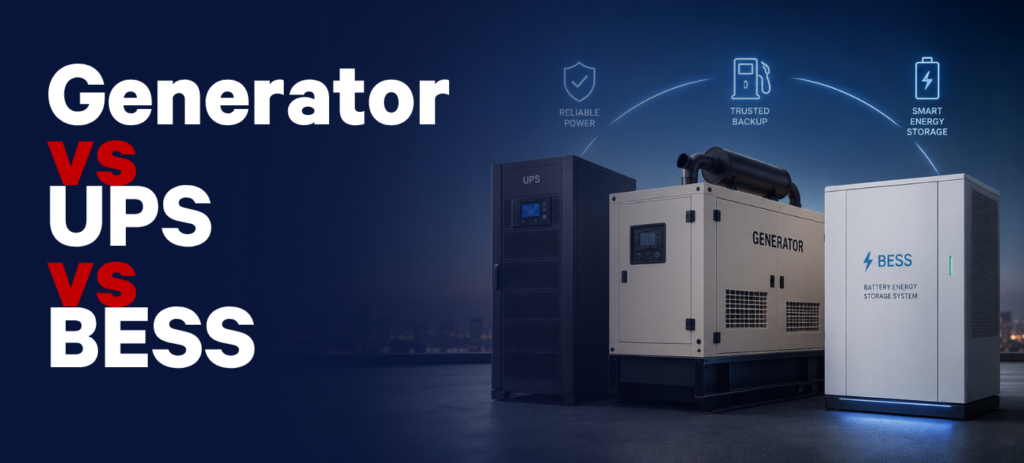
Power cuts are not just an inconvenience for modern businesses. A short interruption can shut down production lines, crash servers, corrupt data, stop payment systems, disrupt refrigeration, disable access control, or create safety risks.
But choosing the right backup power system is not always straightforward. Should your business install a diesel generator, a UPS, a Battery Energy Storage System, or a combination of all three?
The simple answer is this:
A UPS protects you instantly. A generator keeps you running for longer. A BESS stores and manages energy, often with both backup and cost-saving benefits.
The right choice depends on your site, your loads, your tolerance for downtime, and how long you need to keep operating.
Quick Comparison: Generator vs UPS vs BESS
| Feature | Generator | UPS | BESS |
|---|---|---|---|
| Main purpose | Long-duration backup power | Instant no-break power | Stored energy, backup, peak shaving, energy management |
| Typical response | Seconds after start-up | Instant / near-instant | Fast, but depends on system design |
| Best runtime | Hours to days, with fuel | Minutes to hours | Minutes to hours, depending on battery size |
| Best for | Whole-site backup, heavy loads, long outages | Servers, IT, control systems, sensitive electronics | Energy cost reduction, renewables, medium-duration backup |
| Fuel source | Diesel, gas or HVO depending on system | Batteries | Batteries, charged from grid/solar/generator |
| Noise/emissions on site | Yes, depending on fuel and installation | Minimal | Minimal during operation |
| Upfront cost | Moderate to high | Low to high depending on size | Usually higher upfront |
| Maintenance | Engine servicing, fuel checks, load testing | Battery, capacitor and electronics checks | Battery management, cooling, monitoring, safety systems |
| Can reduce energy bills? | Not usually | Not usually | Yes, in the right tariff/load profile |
| Can support solar? | Indirectly | Usually not the main purpose | Yes |
UPS systems are designed to provide immediate short-term protection for sensitive loads, while generators are designed for longer outages and larger loads. BESS sits between and beyond the two: it can provide backup power, but its wider value often comes from storing cheaper or renewable electricity for later use.
What Is a Generator?
A generator produces electricity using an engine and alternator. For business standby power, diesel generators are still one of the most common options, although gas and HVO-compatible systems are also used depending on the application.
Generators are usually installed with an Automatic Transfer Switch, which detects a mains failure and transfers the load to generator power once the generator has started and stabilised.
A generator is usually the best choice when:
| Business Need | Why a Generator Fits |
|---|---|
| You need backup for hours or days | Runtime is mainly limited by fuel supply |
| You have large electrical loads | Generators can support heavy plant, motors, HVAC, pumps and whole buildings |
| You need site-wide resilience | A correctly sized generator can support essential circuits or entire facilities |
| You operate in critical sectors | Healthcare, manufacturing, logistics, utilities, telecoms and data centres often need long-duration standby power |
Generators are particularly suited to extended outages because they can continue running as long as fuel is available. This makes them more practical than a standalone UPS for long-duration resilience.
What Is a UPS?
A UPS, or Uninterruptible Power Supply, provides immediate battery-backed power when the mains supply fails. Its job is to prevent even a brief interruption.
In many businesses, the UPS does not power the whole site. It protects the most sensitive or mission-critical loads.
A UPS is usually the best choice when:
| Business Need | Why a UPS Fits |
|---|---|
| Zero-break power is required | A UPS can protect against even momentary interruptions |
| You need clean, stable power | UPS systems can condition power and protect against voltage issues |
| You need safe shutdown time | It gives IT systems time to shut down properly |
| You need a bridge to generator power | The UPS keeps critical loads live while the generator starts |
UPS systems are commonly used for servers, network infrastructure, control panels, security systems, medical equipment, telecoms equipment and industrial automation. They are especially valuable where even a few seconds of downtime can cause data loss, equipment faults or process disruption.
What Is a BESS?
A Battery Energy Storage System stores electrical energy in large batteries and releases it when required.
Unlike a traditional UPS, a BESS is not only a backup device. It can also be used for:
| BESS Function | What It Means for a Business |
|---|---|
| Backup power | Supports loads during an outage |
| Peak shaving | Discharges during expensive peak demand periods |
| Load shifting | Stores cheaper off-peak electricity for later use |
| Solar storage | Stores excess solar generation for evening or peak-time use |
| Grid flexibility | Can support demand response or flexibility programmes where available |
| Generator optimisation | Can reduce generator runtime or smooth load profiles |
BESS is often described as an energy management asset rather than just an emergency backup product. It can be especially attractive for businesses with high electricity demand, variable tariffs, solar PV, ESG targets or a need to reduce peak demand charges.
Visual Guide: Which System Solves Which Problem?
| Problem | Best Fit |
|---|---|
| “We cannot lose power, even for one second.” | UPS |
| “We need to run for hours during a power cut.” | Generator |
| “We want backup power and lower energy costs.” | BESS |
| “We have servers and a whole building to protect.” | UPS + Generator |
| “We have solar and want to store excess energy.” | BESS |
| “We run critical operations and want maximum resilience.” | UPS + Generator + BESS |
Runtime Comparison
Below is a simplified view of how each technology is normally used.
| Backup Duration | UPS | BESS | Generator |
|---|---|---|---|
| Seconds | Excellent | Good, if designed for fast transfer | Not ideal alone |
| 5–30 minutes | Excellent | Good | Usually starting/taking over |
| 1–4 hours | Possible but expensive | Strong fit | Strong fit |
| 8+ hours | Usually not practical alone | Possible but battery size/cost increases | Strong fit with fuel |
| Several days | Not practical alone | Usually not practical alone | Strong fit with fuel planning |
A UPS is typically used for short-duration, high-quality power. A BESS can be designed for longer battery runtime and energy management. A generator remains the practical choice for long-duration backup where fuel supply can be maintained.
So, Which Backup Power Solution Does Your Business Need?
Here is the simplest way to decide:
Choose a UPS if…
You need instant protection for IT, controls, telecoms, security systems, payment systems or other sensitive electronics.
Choose a generator if…
You need to keep operating through long outages, support large loads or back up an entire site.
Choose a BESS if…
You want backup power plus energy management, peak shaving, solar storage or lower reliance on the grid.
Choose a hybrid system if…
You need resilience, uptime and energy flexibility. For many commercial and industrial sites, the strongest answer is:
UPS for instant protection, generator for long-duration backup, and BESS for energy optimisation.
Final Recommendation
There is no universal winner between generators, UPS systems and BESS. The right solution depends on your risk.
If downtime for a few seconds would damage your business, start with a UPS.
If downtime for a few hours would damage your business, you probably need a generator.
If electricity costs, carbon reduction, solar integration or energy flexibility are part of the challenge, consider a BESS.
For critical operations, the best backup power strategy is often not one technology. It is a properly designed system where each component does the job it was built for.
