
HVO Fuel: Why It Matters (and Why More Backup Power Users Are Switching Now)
February 13, 2026
If you’re specifying, operating, or maintaining standby generators, fuel choice is becoming just as important as kVA. Emissions targets, ESG reporting, planning requirements, and reliability expectations are all moving in the same direction: lower carbon, cleaner operation, and less maintenance risk—without compromising performance.
That’s exactly where HVO (Hydrotreated Vegetable Oil) comes in.
This blog is a practical look at what HVO is, why it’s important, and the key benefits for generator users—especially for standby and emergency power applications.
Checkout YorPower’s new HYPER range, providing eco friendly and ultra-silent standby power
Why HVO is becoming important
Across the UK, more organisations are being asked (or required) to prove progress on decarbonisation and local air quality—especially those operating critical sites like:
- Data centres
- Hospitals
- Facilities management portfolios
- Public sector buildings
- Construction and temporary power installations
HVO provides a straightforward way to cut emissions immediately, without waiting for new infrastructure or alternative technologies that may not suit emergency power requirements.
The key benefits of HVO for generators
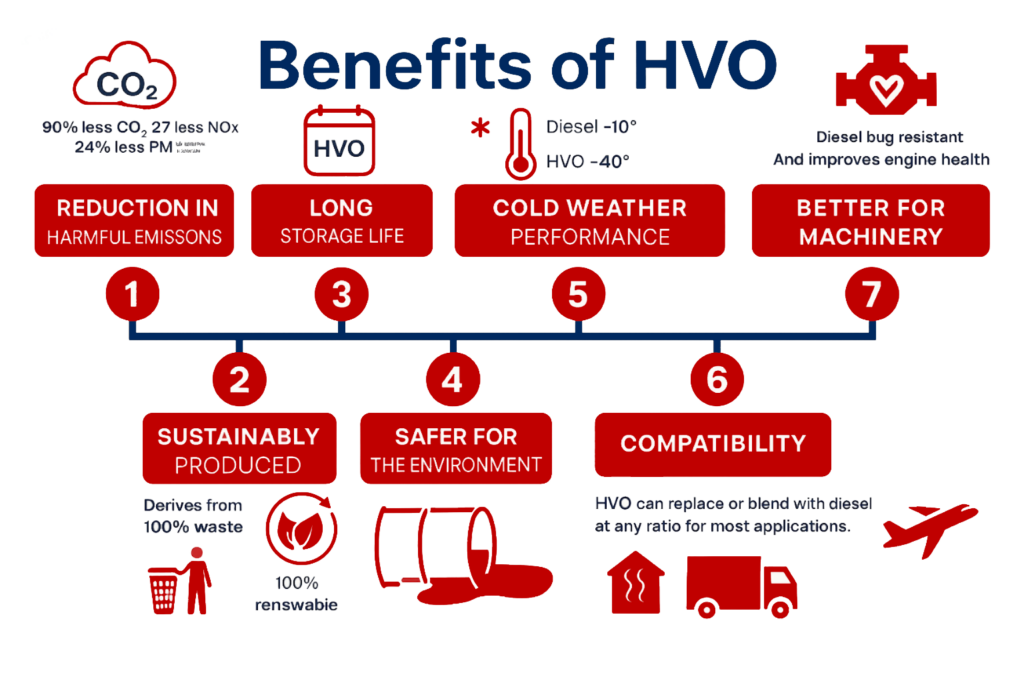
1) Immediate carbon reduction — without equipment changes
HVO enables an “instant” greener transition because it’s a drop-in fuel. For many users, that means decarbonising standby power without replacing assets—useful when equipment lifecycles are measured in decades, not years.
2) Cleaner exhaust emissions (local air quality)
As well as greenhouse gas reduction, HVO can also significantly reduce other emissions:
- Up to 90% greenhouse gas reduction
- Around 30% lower NOₓ
- Around 85% lower particulate matter (PM)
For sites under scrutiny for air quality, this can make a real difference—especially in urban environments and sensitive locations.
3) Better compliance and tender scoring
More tenders and frameworks now reward lower-carbon solutions. Using HVO can help you:
- Strengthen ESG narratives
- Improve SECR reporting
- Support green building goals (such as BREEAM/LEED-aligned projects)
In other words: HVO isn’t just a fuel choice—it’s a commercial advantage.
4) Long storage life (a big deal for standby generators)
This is one of the most practical benefits for backup power users:
- Diesel storage life is typically ~1 year, and is vulnerable to microbial contamination and degradation.
- HVO can be stable for up to 10 years and is far more resistant to microbial growth.
If your generator is true standby (used rarely, but must work perfectly), long-life fuel reduces risk and removes a major maintenance headache.
5) Reduced maintenance and fewer fuel-related issues
Because diesel is prone to contamination, many sites rely on fuel polishing to keep stored fuel usable. In the deck’s 10-year example (1,000 litres/year), diesel polishing was estimated at around £1,300 per year—£13,000 over 10 years. HVO removes (or dramatically reduces) that requirement.
Even though HVO may cost more per litre, the reduction in polishing and fuel-related problems can flip the long-term cost equation.
HVO vs Diesel: a simple 10-year cost takeaway
In the presentation’s sample analysis (1,000 litres annually over 10 years):
- Diesel fuel cost (10 yrs): ~£12,000
- HVO fuel cost (10 yrs): ~£13,500
- Diesel fuel polishing (10 yrs): ~£13,000
- HVO polishing (10 yrs): £0 (assumed)
Result: total estimated cost over 10 years
- Diesel: ~£25,000
- HVO: ~£13,500
That’s a potential ~£10,000–£11,500 saving over a decade when fuel polishing is part of the equation.
Who should consider HVO first?
HVO is especially suited to:
- Emergency/standby generators (low run hours, long storage periods)
- Sites with ESG or carbon reporting pressure
- Urban or sensitive environments where PM/NOₓ matter
- Fleet owners and hire companies wanting cleaner temporary power options
If your generator runs heavily every day, diesel may still look cheaper on direct fuel price alone—but for most standby and compliance-driven users, HVO is increasingly the smarter choice.
The YorPower view
You’re buying diesel reliability—but that doesn’t mean you have to burn fossil fuel.
HVO gives organisations a way to reduce carbon, improve local emissions performance, and simplify fuel management, while keeping the dependable generator performance that critical sites require.
