
Is your business ready for a winter power cut?
October 28, 2026
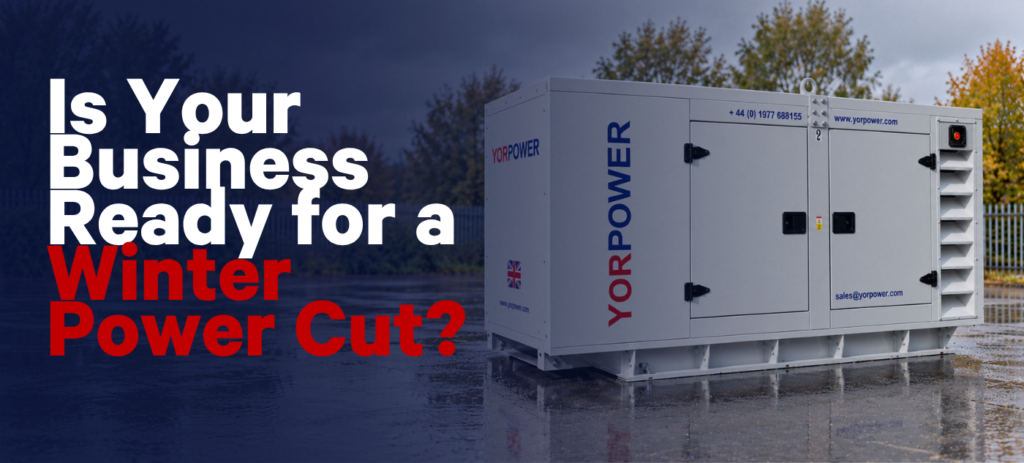
A winter outage can bring work to a halt, spoil stock or interrupt essential services. Strong winds, fallen branches, flooding, ice and snow can all disrupt electricity supplies, while cold snaps can push demand higher.
Your backup plan might use a UPS, a standby generator, or both. The right choice depends on what your site needs to keep running and for how long.
October has shown how quickly disruption can spread
Storm Austen and Storm Boelo brought power cuts and disruption across parts of the UK this month. A separate power event at a London data centre affected cloud services used by multiple businesses. It’s a timely reminder that outages can interrupt both local operations and the digital services companies rely on.
The impact depends on the business. A retailer may lose refrigeration and card payments; a manufacturer may face downtime and a difficult restart; a care facility may need to protect critical equipment and communications. For any organisation, there can be lost income, wasted stock, safety concerns and damage to customer confidence.
Where a UPS can help
A UPS provides battery power immediately when mains electricity fails. It can help keep sensitive equipment supplied during a brief interruption or while another backup source starts. Depending on the site design, this may include CCTV cameras and recorders, IT and communications, access control, alarms and building controls.
Emergency lifts need particular care. A lift-specific UPS or rescue arrangement may help move a lift to a safe landing or support essential controls and communications. The correct solution depends on the lift and its safety design; a general-purpose UPS shouldn’t be assumed to run it normally.
When a generator makes sense
A standby generator can provide power for longer outages, supplying the circuits your business has identified as essential. That could mean refrigeration, selected production equipment, pumps, heating controls or critical building systems.
The generator can be used on its own, or alongside a UPS where equipment needs uninterrupted power during changeover. YorPower supplies and supports generator and UPS systems, including installations designed to work together.
Industries where continuity matters
The generator capacity needed varies from site to site. These broad ranges are examples for early planning, not fixed requirements:
| Business type | Indicative standby range |
|---|---|
| Small office or clinic | 20–150 kVA |
| Retail shop or restaurant | 30–250 kVA |
| Supermarket or larger hotel | 150–500 kVA |
| Warehouse or logistics site | 60–500 kVA |
| Manufacturing facility | 100 kVA to 1 MVA+ |
| Hospital | 250 kVA to several MVA |
| Data centre | 500 kVA to several MVA |
| Farm or food production site | 30–250 kVA |
Healthcare, retail, hospitality, logistics, manufacturing, agriculture, data centres and public services can all have equipment that depends on dependable power. A small site may only need to protect a handful of circuits; a large facility may need a much more substantial system.
Actual sizing depends on running loads, equipment start-up demand, the order in which systems come online and the required runtime. Motors, pumps and HVAC units can draw extra current when they start, so a proper load assessment is essential—especially for critical applications.
Make arrangements before the weather turns
List the systems your business can’t afford to lose, then decide how long each one needs backup. Consider whether a UPS, a generator or a combination is appropriate, and include regular servicing and testing in the plan.
YorPower can help businesses with system design, supply, installation, commissioning and ongoing maintenance. Contact the team to discuss your site’s requirements. It’s easier to plan for winter power cuts before the next one arrives. and UPS Systems
View our range of diesel generator and UPS Systems.
