
Why Choose a Silent Generator? Noise, Neighbours & Compliance
February 16, 2026
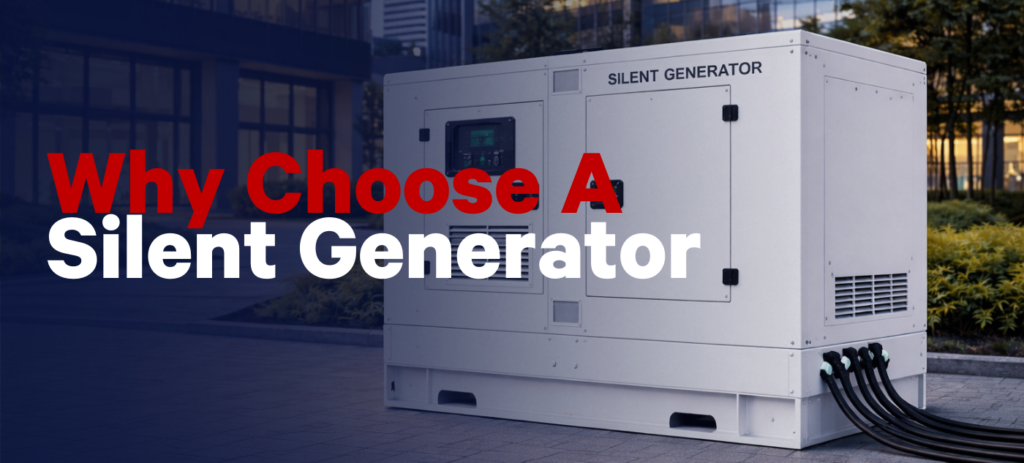
When reliable power is non-negotiable, generator noise can become the deciding factor – especially in built-up or noise-sensitive environments. That’s why ultra-quiet generator solutions aren’t just a “nice to have”: they can protect local communities, support planning and compliance, and help sites operate with fewer complaints and fewer constraints.
Why generator noise matters more than most people think
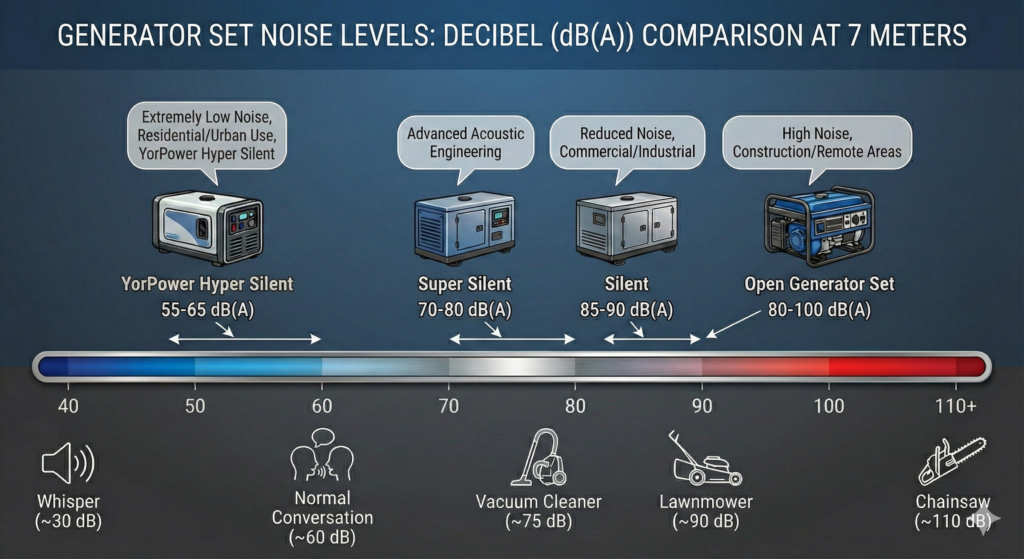
Sound travels — and it doesn’t need to be painfully loud to be disruptive. A “standard” silenced diesel generator is often still in the region of 75–85 dB(A) at 1 metre (varies by size and build).
And at common reference distances used in specifications, many diesel generators are still quoted around 70–85 dB at roughly 7 metres (23 ft).
So the difference between “standard silent” and “hyper silent” isn’t trivial — it’s the difference between background presence and a sound that dominates the area.
Checkout YorPower’s new HYPER range, providing ultra-silent generators.
The real-world impact on surrounding areas
A generator’s noise profile can affect more than the room it’s installed in:
- Neighbouring residents: night-time operation, testing schedules, and emergency running can trigger complaints quickly when a site backs onto housing.
- On-site working conditions: sustained exposure at higher levels increases the need for hearing protection, zoning, and controls (in the UK, action levels start at 80 dB(A) and increase at 85 dB(A), with a legal exposure limit value of 87 dB(A) after accounting for hearing protection).
- Reputation and stakeholder relationships: venues, landlords, hospitals and councils are all sensitive to noise impact — and noise issues can derail otherwise straightforward projects.
Generator noise and compliance: where “quiet” becomes “necessary”
In the UK, generator noise is often assessed in relation to nearby “noise-sensitive receptors” — typically homes — and many projects lean on BS 4142 methodology to assess the likely impact of industrial/commercial sound on residents.
In practical terms, the quieter the generator system, the easier it is to:
- demonstrate acceptability in noise assessments,
- reduce the need for additional acoustic barriers,
- and avoid limitations on test times or runtime.
Who needs hyper-silent power (without sacrificing kVA)?
Ultra-low noise isn’t only for small portable sets. In fact, the biggest need is often high power in sensitive locations, such as:
- Healthcare & care environments: hospitals, clinics, care homes — where patient rest and wellbeing matter.
- Offices near residential areas: business parks and city-edge sites where boundaries sit close to homes.
- Event venues & temporary infrastructure: concerts, festivals, film sets and broadcast — where power demand is high, but audience and neighbour experience is everything.
Our direction: hyper-silent, high-power, compliance-ready
This is exactly why YorPower is bringing a new solution to market that pairs super-silent container technology (down to ~55 dB(A) in the right configuration) with HVO-ready generation — designed for modern compliance expectations, emissions goals, and practical operation where noise matters most. (55 dB(A) at 7 m is widely recognised as an ultra-low benchmark for sound-attenuated generator enclosures.)
If you’re planning power for a noise-sensitive site — or you’ve previously had issues with complaints, restricted testing windows, or planning conditions — we can help you design a specification that hits both power and peace and quiet.
Want to talk through your site and noise requirements? Get in touch with YorPower and we’ll recommend the best approach for your location, duty profile, and compliance needs.
