
Why Does a UPS Need a Load Bank Test If It Runs Regularly?
April 2, 2026

A common question in backup power maintenance is: why does a Uninterruptible Power Supply (UPS) need a load bank test if it is already running on load regularly?
At first glance, the logic seems sound. If the UPS System is operating continuously and supporting connected equipment without issue, surely that proves it is healthy and ready to perform when needed.
Unfortunately, that is not always the case.
While regular operation does confirm that the UPS is functioning in day-to-day conditions, it does not fully prove that the system can perform at full capacity during a mains failure or other critical power event. A load bank test remains one of the most important ways to verify the true condition and resilience of the system.
Regular operation is not the same as full performance testing
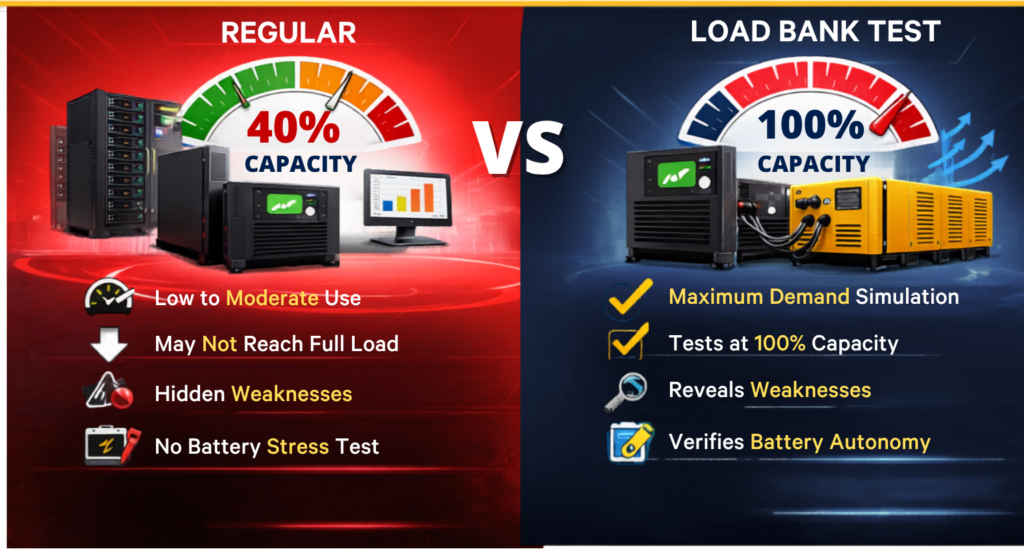
A UPS in normal service is typically supporting a live load, but that load may only represent a portion of its rated capacity. In many installations, the actual demand can fluctuate or remain well below the UPS’s maximum output.
This means the UPS may appear healthy in everyday use while hidden issues remain undetected. A load bank test allows engineers to apply a controlled and measurable load to the system, confirming whether it can carry the required demand under real-world emergency conditions.
In simple terms, a UPS that runs regularly is being used, but it is not necessarily being properly challenged.
Verifying battery autonomy
One of the main reasons for load bank testing is to confirm battery autonomy. The battery set is the heart of any UPS during a power outage, yet batteries are also one of the most common points of failure.
Over time, batteries degrade due to age, temperature, charging conditions and general wear. A UPS may still show normal readings and appear healthy on alarms and monitoring systems, but that does not guarantee the batteries will support the load for the required runtime when mains power fails.
A load bank test puts the batteries under a realistic discharge condition and reveals whether they can:
- support the intended load
- maintain voltage correctly
- deliver the expected backup time
- perform reliably under sustained demand
Without this type of test, battery weakness may only become obvious when the UPS is needed most.
Checking transient response
Another critical factor is transient response. In a real power event, the UPS must respond instantly to changes in supply conditions and load demand. It is not enough for the unit to simply remain on; it must transfer, regulate and stabilise power without disruption.
A load bank test helps assess how the UPS behaves during these changing conditions. Engineers can observe how the system responds to load steps, switching events and simulated failures, ensuring it maintains stable output throughout.
This is especially important in environments where sensitive equipment depends on a clean and uninterrupted power supply, such as data centres, hospitals, telecoms facilities and industrial sites.
Revealing the true condition of ageing components
UPS systems contain a range of electrical and electronic components that can deteriorate over time. Capacitors, fans, connections, power electronics and battery strings may all show signs of wear long before a fault alarm appears.
Under normal operating conditions, these weaknesses may remain hidden because the system is not being pushed hard enough to expose them. Under maximum stress, however, aging components are much more likely to reveal poor performance, overheating, instability or reduced capacity.
A load bank test provides a controlled way to assess the UPS under these demanding conditions. It gives maintenance teams a more realistic picture of the system’s health and allows them to address issues before they become critical failures.
Confidence in emergency readiness
The purpose of a UPS is not simply to operate every day. Its true role is to protect critical loads when the incoming power supply fails. That moment of failure is when the system has to prove itself.
Routine operation alone cannot provide complete confidence that the UPS will perform as expected during a real outage. A load bank test is about validating emergency readiness, not just normal operation.
It answers important questions such as:
- Can the UPS support the full required load?
- Will the batteries last for the specified runtime?
- Does the system remain stable under stress?
- Are there hidden weaknesses that everyday use has not exposed?
These are questions that standard running conditions cannot always answer.
A key part of planned UPS servicing & maintenance
Load bank testing should be seen as part of a wider preventative maintenance strategy rather than an optional extra. Combined with routine inspections, thermal checks, battery testing and servicing, it helps ensure the UPS remains dependable throughout its working life.
For businesses that rely on constant power availability, the cost of a controlled test is small compared to the potential consequences of UPS failure during a genuine outage.
Final thoughts
A UPS running regularly on load is a positive sign, but it is not proof of full emergency capability. Regular operation confirms day-to-day functionality, while a load bank test confirms whether the system can truly deliver when it matters most.
From verifying battery autonomy to assessing transient response and uncovering the real condition of aging components, load bank testing gives a far more complete picture of UPS performance.
When power security is critical, assumptions are not enough. Testing provides certainty.
