
Generator Hire vs Purchase for Backup Power: What Makes Commercial Sense Long Term
March 10, 2026
The question comes up constantly. A project needs standby power, or a site’s permanent generator is down, or a new facility isn’t ready for its installed system yet, and someone needs to decide whether to hire or buy. It’s usually framed as a simple cost question. It isn’t.
The right answer depends on how long you need the unit, how often you’ll need it in the future, what your capital position looks like, and whether temporary cover or permanent resilience is the actual goal. Getting it wrong in either direction is expensive: buying when hire makes more sense ties up capital unnecessarily, while long-term hire for a permanent requirement costs significantly more over a five or ten year horizon.
Here’s how to work through it properly.
Where Generator Hire Wins Outright
There are scenarios where hire is clearly the better option, and it’s worth being direct about them.
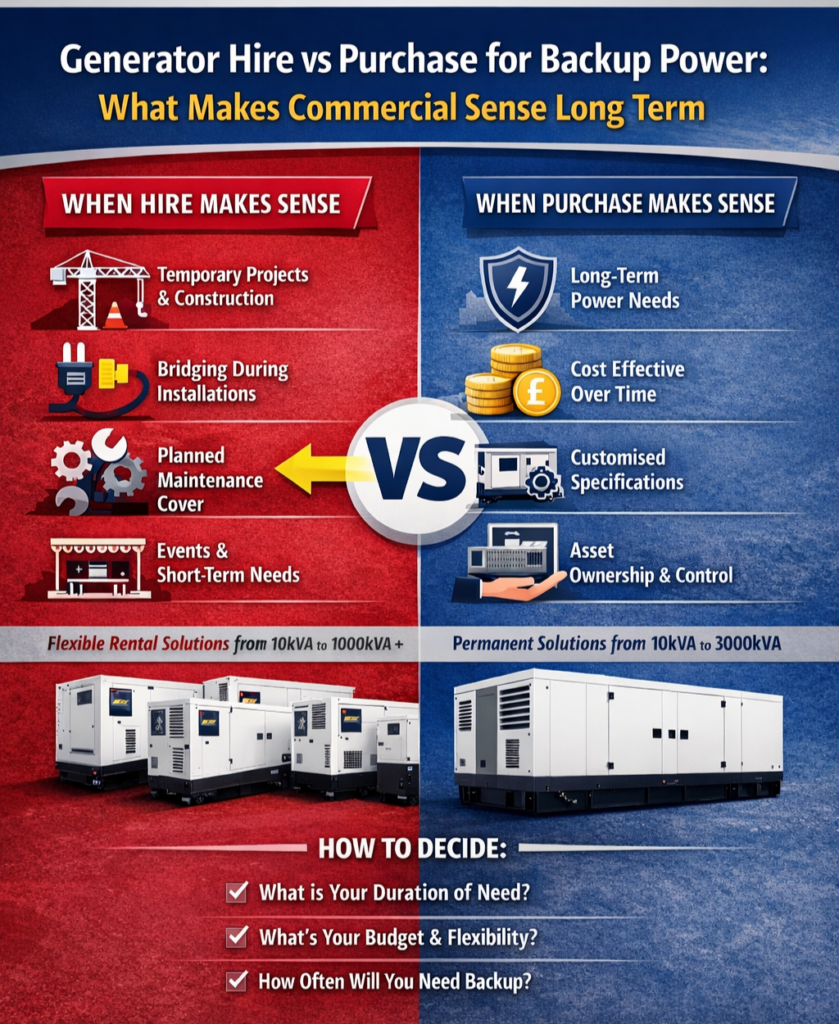
Construction and temporary site power is the classic hire use case. A site running for 12 to 18 months needs reliable power throughout, but there’s no asset to leave behind when the project ends. Hiring a generator on a short or medium-term basis keeps the cost on-project and ensures the unit is maintained and supported without your team needing any technical capability in-house.
Bridging whilst a permanent system is installed. Planning permission, DNO connection and bespoke manufacturing lead times all add up, and permanent generator installations take time. A business that’s identified a power resilience gap but can’t bring a permanent system online immediately needs cover in the interim. Hire fills that gap without committing to a purchase decision before the permanent spec is confirmed.
Planned maintenance cover. If your installed generator goes offline for a major service, a rebuild, or a fault repair, the backup is suddenly the backup to the backup. Hiring a unit to cover the gap means your critical systems are never unprotected. This is particularly important for healthcare, data centre, and manufacturing sites where downtime costs are high.
One-off events and short-duration critical requirements. A stadium, a temporary medical facility or a large outdoor event: hire gives you exactly the capacity you need for the duration, delivered, installed, and removed.
YorPower handles all of these through its hire operation, distributing through Leeds, London, and Manchester with delivery across the UK. The hire fleet runs from small single-phase domestic units up to 1000kVA, with larger capacity available on request. Rental periods range from a single day up to three years, and the 24-hour breakdown cover means a fault at 2am isn’t an unsupported problem.
The Long-Term TCO Case for Purchase
For any organisation that needs standby power on a permanent basis, the economics of ongoing hire deteriorate quickly.
Hire rates for a commercial generator typically include the unit itself, basic maintenance, and breakdown support. They don’t include everything: fuel, certain consumables and sometimes specific callouts sit outside the contract. Over a five-year period, even a modest hire rate accumulates to a capital outlay that would have purchased a good-quality unit outright, potentially with money left for the first two or three services.
Ownership also gives you control. You specify the unit to match your exact load requirements, you choose your maintenance provider and schedule, and you retain the asset value at the end of the service life. A well-maintained diesel generator from a reputable manufacturer such as Perkins, Cummins or FG Wilson will run reliably for 20 to 30 years with proper servicing. That’s an asset, not an expense.
There’s also a planning and compliance angle. Larger commercial generators installed permanently will be part of your site’s electrical infrastructure, often subject to DNO notification requirements and load calculations that make a bespoke, site-specified unit the appropriate solution. A generic hire unit won’t always meet those requirements.
YorPower manufactures its own branded generators at its Yorkshire facility and is an authorised dealer for Cummins, Perkins, CAT, and FG Wilson. The range runs from 10kVA to 3000kVA, covering everything from smaller commercial applications up to large industrial and data centre requirements. For businesses making a permanent investment, it’s worth spending time on the specification before purchase, including whether the system should incorporate UPS, ATS, fuel storage, and permanent hybrid energy and backup power systems.
A Simple Decision Framework
The question isn’t hire vs purchase in the abstract. It’s about your specific situation. Work through these:
Duration of requirement: Under 18 months, hire is almost always cheaper. Over three years, purchase is almost always cheaper. The 18 to 36 month range is where it gets nuanced.
Frequency of future need: A business that will regularly need temporary generator cover for projects, maintenance, or events is better served maintaining a relationship with a reliable hire provider than purchasing a unit that sits idle between uses.
Capital availability and accounting treatment: Hire sits as an operating expense. Purchase is a capital investment. Depending on your organisation’s financial position and accounting preferences, that distinction can matter independently of the pure cost calculation.
Specification flexibility: If your power requirement is likely to change, whether through site expansion, new equipment or a changed load profile, hire gives you the ability to scale the unit size. A permanent purchase locks in the specification, though properly sized units from an experienced supplier shouldn’t become obsolete quickly.
Maintenance capability: Hire contracts include maintenance. Purchase requires either an in-house capability or a service contract with a specialist. YorPower’s generator servicing and maintenance covers all major brands, so this needn’t be a barrier to purchase, but it’s a cost that needs to go into the comparison.
Getting the Numbers Right
The mistake most organisations make is comparing hire cost against purchase price in isolation. The right comparison is total cost of ownership over your expected requirement period: hire cost (including any extras outside the standard contract) versus purchase price plus installation, servicing over the period, and any financing costs if the purchase is funded rather than paid outright.
That calculation looks different for a 50kVA unit than a 500kVA one, and it looks different again for a 12-month requirement versus a 10-year one. There isn’t a universal answer, but there is a clear methodology.
If you’re working through this decision, YorPower’s team can help model the requirements against your specific situation. Whether the right answer is hire, purchase, or hire now with a defined path to a permanent installation, getting independent advice from a supplier that genuinely offers both is worth the conversation.
Call the team on 01977 688155 or view YorPower’s hire fleet and diesel generator range to start comparing options.
